Sunday, April 6, 2014

Why Urban Agriculture?

What can green roofs do for us, you might ask?  How is it accomplished?  Great questions!  Let's watch a short video:


But what does gardening in general even have to do with the urban landscape?  Another excellent question, answered by video:


AND one more question: WHY SHOULD WE CARE??!?  One answer: Food Transparency.  It's important.  Where did that head of lettuce come from?  How was it grown?  What pesticides were used?  Why are those chicken breasts on such a wicked sale than the ones next to them, what's been done to them?  Why is this tomato healthy looking while this one already smells like moldy bread?  These are important things to ask!  I know, I said only one more question and then I rained a volley down.  But that's because this is IMPORTANT!  We should know about these things.  We don't let a child stick a penny down their throats and THEN ask if it was a smart decision.  Something in us knows that penny shouldn't be anywhere NEAR a kid.  Why are we so knowledgeable about the dangers of that penny, but not the dangers that could be in our egg yolks?

Reclaiming our food is important, and urban cities using urban agriculture are leading the way in that reclamation process.  Families are eating healthier at a fraction of the cost in cities that encourage sustainable and ethical food production.

The environment is something we are all TOLD we should care about, but particularly urban areas there is a distancing between direct nature to human contact, and that blunts the importance of the message that we are only as healthy as the environment that sustains us.  Urban youth growing up in smog-infested cities have no idea about clean air.  They don't know what a rooster acts like in real life.  They understand that it costs a few quarters to feed a goat in a zoo, if they're brave enough to get close enough to it's mouth.  Cornell University student Alexey Kudryavtsev explored the phenomenon of finding "place" for urban students in environmental stewardship as part of his dissertation in attaining a Ph.D. in Philosophy.  His essay explores how urban students are capable of understanding their environmental impact and how they can change the norm and promote sustainability when they are exposed to the education behind environmentalism.  They also understand the need to bring nature back to the cities and use it as a way of creating positive local ecosystems that in turn create jobs and promote economic and food security for themselves and their peers.

Wouldn't it be wonderful if adults were as enthusiastic about their ability to change the environment in which they live in positive ways?  Oh, wait.  One last video of the day: they ARE and they're waiting for YOU!


Thursday, March 27, 2014

An Outline of Goals and the Hanging Gardens of... Ninevah???

As we progress into the world of rooftop gardening, we will need goals to define what will be learned (specifically, as this blog is a school project, this entry is designed to let the instructor and fellow students know what will be covered and, hopefully, earn a passing grade!)

The benefits of rooftop gardening are more than just providing a self-sustaining food source.  Theodore Theodosiou from the Department of Mechanical Engineering at the University of Western Macedonia identifies the following benefits of rooftop gardening in his article "Green Roofs in Buildings: Thermal and Environmental Behavior" (see source note at end):


  • energy conservation and cooling
  • reduction in the urban heat island effect
  • absorption of air pollutants and dust
  • attenuation of stormwater run-off
  • extension of life for waterproofing layers
  • attractive open space (aesthetic benefits)
  • provision of wildlife habitat
  • replacement of vegetation and habitat lost during urban expansion
  • reduction of urban noise
  • social and psychological benefits

More of Theodosiou's findings and research will be incorporated in additional posts and is used here to form a background for expanding on the benefits and various uses for rooftop gardens and their construction.  The list above serves as a springboard and general outline for blog topics.

There's quite a bit of "ground" to cover (pun intended) when it comes to rooftop gardening, and while no one college student working towards a degree in history and anthropology can ever hope to become an expert, it is my hope that as we go forward and learn together we will become interactive.  Perhaps one of you knows something I fail to uncover in my research, or will pose a question to something obvious I have missed.  The learning experience will be for everyone, unless you happen to be someone who has already figured out the benefits, physics and mechanics of rooftop gardening and are celebrating your most recent harvest.  If that's the case, send me a picture and bring me some lunch!

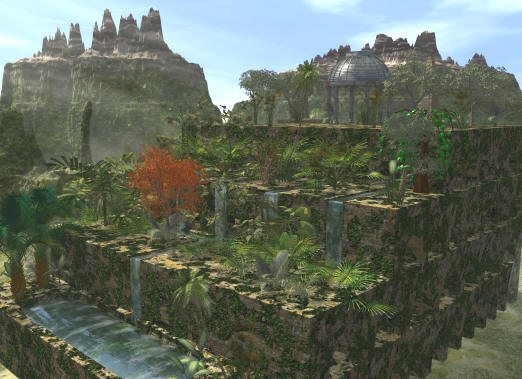
Here you will find an interesting and brief timeline of the history of gardening.  Among the list we find a garden so impressive for it's ingenuity and largess in the ancient times that it became one of the Seven Wonders of the Ancient World: the Hanging Gardens of Babylon.   Built by King Nebuchadnezzar as a wedding gift to his bride, Amytis, the phrase "hanging gardens" is incorrect.  What was created in 600 BC was, in fact, a series of rooftop gardens constructed on terraces of multiple heights.


This photo, provided by a site outlining the Seven Wonders of the Ancient World, shows an artist depiction of what the gardens may have looked like.  From below looking up, the vegetation would have appeared to "float" giving rise to the term "hanging gardens."

Archaeologists have yet to uncover evidence that the Hanging Gardens of Babylon existed... in Babylon.  New evidence has been excavated to suggest the gardens DID exist, but 340 miles away in the city of Ninevah, where extensive aquaducts have been found deep in the ground.  Indeed, with this discovery the entire romantic history of the gardens has been brought into question.  However, one thing is clear: the technology existed over 2,000 years ago, and was as intriguing and beneficial then as it is today.

Unlinked Source:
Theodosiou, Theodore. "Green Roofs in Buildings: Thermal and Environmental
     Behavior." 
Advances in Building Energy Research. 3. (2009): 271-288.
     ProQuest, March 21, 2014.

Wednesday, March 26, 2014

As we look across the cityscape of urban living, we notice something: industrialism.  Our city lives have been taken over by machines.  In Wichita, Kansas, carpools are as mythic as the centaur.  Outside the city limits land lays fallow waiting on developers with the highest bid to build more buildings, reminiscent of the ticky-tacky boxes on the hillside:


As we continue to crowd out anything natural in our lives in favor of the latest stainless steel appliances in our homes and stainless steel art that flutters in the wind, there is still hope.  Urban food markets are bringing in fresh produce.  Farmer's markets are springing up throughout the city, and people are taking a renewed interest in becoming self-sustaining.

The phenomenon of rooftop gardening allows civic-minded citizens to give back to their city and increases food sustainability for local persons, both those who have fallen on hard times and those with an interest in creating a lifestyle that fuels local economy.

Feminist principles of community service and civic-mindedness directly benefit from the ideals of rooftop gardening, mainly for it's environmental and social constructs that encourage people to provide not only for themselves, but also for others in coming together as a community.  The reduction in noise pollution and the well-being benefits found in rooftop gardening provide additional benefit.  Gardening brings like-minded people together and spreads knowledge.  All of these benefits fit into feminist principles.

This is a journey to re-connect to nature.  Urban agriculture explores the benefits of community involvement in life-sustaining food sources that anyone can participate in.  Join me in a search for our touch-stone with the environment.