The benefits of rooftop gardening are more than just providing a self-sustaining food source. Theodore Theodosiou from the Department of Mechanical Engineering at the University of Western Macedonia identifies the following benefits of rooftop gardening in his article "Green Roofs in Buildings: Thermal and Environmental Behavior" (see source note at end):
- energy conservation and cooling
- reduction in the urban heat island effect
- absorption of air pollutants and dust
- attenuation of stormwater run-off
- extension of life for waterproofing layers
- attractive open space (aesthetic benefits)
- provision of wildlife habitat
- replacement of vegetation and habitat lost during urban expansion
- reduction of urban noise
- social and psychological benefits
More of Theodosiou's findings and research will be incorporated in additional posts and is used here to form a background for expanding on the benefits and various uses for rooftop gardens and their construction. The list above serves as a springboard and general outline for blog topics.
There's quite a bit of "ground" to cover (pun intended) when it comes to rooftop gardening, and while no one college student working towards a degree in history and anthropology can ever hope to become an expert, it is my hope that as we go forward and learn together we will become interactive. Perhaps one of you knows something I fail to uncover in my research, or will pose a question to something obvious I have missed. The learning experience will be for everyone, unless you happen to be someone who has already figured out the benefits, physics and mechanics of rooftop gardening and are celebrating your most recent harvest. If that's the case, send me a picture and bring me some lunch!
Here you will find an interesting and brief timeline of the history of gardening. Among the list we find a garden so impressive for it's ingenuity and largess in the ancient times that it became one of the Seven Wonders of the Ancient World: the Hanging Gardens of Babylon. Built by King Nebuchadnezzar as a wedding gift to his bride, Amytis, the phrase "hanging gardens" is incorrect. What was created in 600 BC was, in fact, a series of rooftop gardens constructed on terraces of multiple heights.
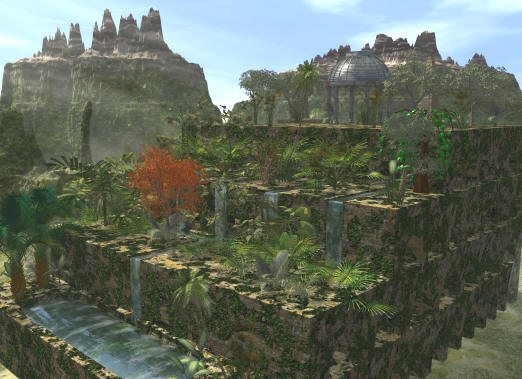
This photo, provided by a site outlining the Seven Wonders of the Ancient World, shows an artist depiction of what the gardens may have looked like. From below looking up, the vegetation would have appeared to "float" giving rise to the term "hanging gardens."
Archaeologists have yet to uncover evidence that the Hanging Gardens of Babylon existed... in Babylon. New evidence has been excavated to suggest the gardens DID exist, but 340 miles away in the city of Ninevah, where extensive aquaducts have been found deep in the ground. Indeed, with this discovery the entire romantic history of the gardens has been brought into question. However, one thing is clear: the technology existed over 2,000 years ago, and was as intriguing and beneficial then as it is today.
Unlinked Source:
Theodosiou, Theodore. "Green Roofs in Buildings: Thermal and Environmental
Behavior." Advances in Building Energy Research. 3. (2009): 271-288.
ProQuest, March 21, 2014.
Behavior." Advances in Building Energy Research. 3. (2009): 271-288.
ProQuest, March 21, 2014.
